Reactor Flux에서 사용하는 스케쥴링은 publishOn()과 subscribeOn()을 이용하여 쓰레드를 분리하는 것임
그러나 설명만으로는 스케쥴링 계획과 쓰레드 분리에 대해 이해하기 쉽지 않은 관계로, 직관적으로 이해할 수 있도록 흐름도를 그려보았음
publishOn()이나 subscribeOn()을 사용하지 않는 경우
        Flux.range(1, 3)
                .map(i -> {
                    System.out.println("1st map(): " + Thread.currentThread().getName() + " " + i);
                    return i;
                })
                .map(i -> {
                    System.out.println("2nd map(): " + Thread.currentThread().getName() + " " + i);
                    return i;
                })
                .subscribe(i -> {
                    System.out.println("subscribe():" + Thread.currentThread().getName() + " " + i);
                });
- chain 상의 모든 연산이 main 쓰레드에서 실행됨
- 그러므로 순차 실행되어 동시성이 낮음
1st map(): main 1
2nd map(): main 1
subscribe():main 1
1st map(): main 2
2nd map(): main 2
subscribe():main 2
1st map(): main 3
2nd map(): main 3
subscribe():main 3
publishOn()
publishOn() 앞쪽의 publisher chain는 그대로 두고 뒷쪽의 subscriber chain만 별도의 쓰레드로 분리함
비유하자면 "과거와는 결별하고 나는 나만의 길을 가겠어!"라는 의미에 가까움
일반적으로 빠른 publisher와 느린 subscriber로 chain이 구성될 때 사용함. 외부 의존성에 쓰기를 수행할 때 필요함
        Flux.range(1, 3)
                .map(i -> {
                    System.out.println("1st map(): " + Thread.currentThread().getName() + " " + i);
                    return i;
                })
                .publishOn(schedulerA)
                .map(i -> {
                    System.out.println("2nd map(): " + Thread.currentThread().getName() + " " + i);
                    return i;
                })
                .blockLast();
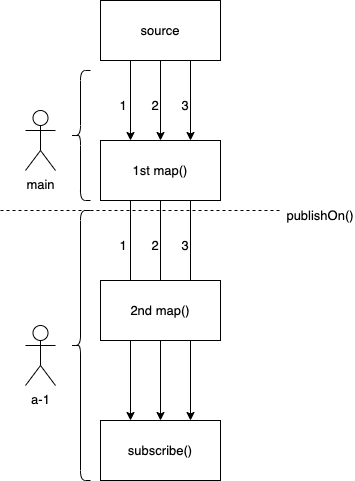
- 1st map()과 2nd map() 사이에서 publishOn()이 호출됨
- 2nd map()부터는 분리되어 스케쥴러A가 담당함
- 스케쥴러A가 a-1 쓰레드를 생성함
1st map(): main 1
1st map(): main 2
1st map(): main 3
2nd map(): scheduler-a-1 1
subscribe():scheduler-a-1 1
2nd map(): scheduler-a-1 2
subscribe():scheduler-a-1 2
2nd map(): scheduler-a-1 3
subscribe():scheduler-a-1 3
publishOn()을 두 번 사용
        Flux.range(1, 3)
                .map(i -> {
                    System.out.println("1st map(): " + Thread.currentThread().getName() + " " + i);
                    return i;
                })
                .publishOn(schedulerA)
                .map(i -> {
                    System.out.println("2nd map(): " + Thread.currentThread().getName() + " " + i);
                    return i;
                })
                .publishOn(schedulerB)
                .map(i -> {
                    System.out.println("3rd map(): " + Thread.currentThread().getName() + " " + i);
                    return i;
                })
                .subscribe(i -> {
                    System.out.println("subscribe():" + Thread.currentThread().getName() + " " + i);
                });
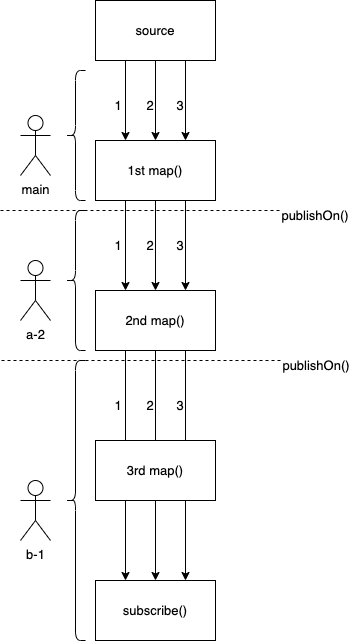
- 1st map()과 2nd map(), 2nd map()과 3rd map() 사이에서 각각 publishOn()이 호출됨
- 2nd map()부터 뒷쪽 chain을 스케쥴러A가 담당하고, 3rd map()부터 뒷쪽 chain을 스케쥴러B가 담당함
그러나 스케쥴링 계획의 순서와 실제 쓰레드 생성 순서는 상이함- 쓰레드 생성 순서는 chain을 거슬러 올라가면서 순서대로 부여되므로,
b-1이 먼저 생성되고a-2가 나중에 생성되었음을 알 수 있음
- 쓰레드 생성 순서는 chain을 거슬러 올라가면서 순서대로 부여되므로,
1st map(): main 1
1st map(): main 2
1st map(): main 3
2nd map(): scheduler-a-2 1
2nd map(): scheduler-a-2 2
2nd map(): scheduler-a-2 3
3rd map(): scheduler-b-1 1
subscribe():scheduler-b-1 1
3rd map(): scheduler-b-1 2
subscribe():scheduler-b-1 2
3rd map(): scheduler-b-1 3
subscribe():scheduler-b-1 3
subscribeOn()
subscribeOn() 앞쪽의 publisher chain와 뒷쪽의 subscriber chain을 함께 묶어서 별도의 쓰레드로 분리함
비유하자면 "과거의 책임자들을 다 내쫓고 내가 다 책임지겠어!"에 가까움
subscribeOn()이 호출되는 위치와 상관없음
일반적으로 느린 publisher와 빠른 subscriber로 구성된 chain에서 사용함. 외부 의존성으로부터 읽어올 때 subscribeOn()을 사용하는 게 필요함
        Flux.range(1, 3)
                .map(i -> {
                    System.out.println("1st map(): " + Thread.currentThread().getName() + " " + i);
                    return i;
                })
                .subscribeOn(schedulerA)
                .map(i -> {
                    System.out.println("2nd map(): " + Thread.currentThread().getName() + " " + i);
                    return i;
                })
                .subscribe(i -> {
                    System.out.println("subscribe():" + Thread.currentThread().getName() + " " + i);
                });
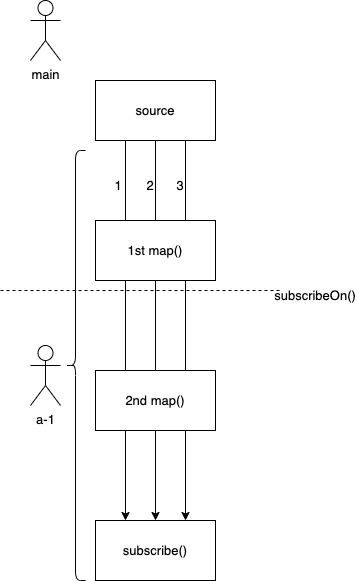
- 1st map()과 2nd map() 사이에서 subscribeOn()이 호출됨
- subscribeOn() 앞뒤의 publisher chain과 subscriber chain을 묶어서 스케쥴러A가 담당함
- 스케쥴러A가 a-1 쓰레드를 생성함
- 하나의 쓰레드로 동작하므로 데이터 아이템 하나씩 source로부터 subscribe()까지 흘러 내려간 다음에 다음 데이터 아이템이 처리됨
- 동시성이 높지 않음
1st map(): scheduler-a-1 1
2nd map(): scheduler-a-1 1
subscribe():scheduler-a-1 1
1st map(): scheduler-a-1 2
2nd map(): scheduler-a-1 2
subscribe():scheduler-a-1 2
1st map(): scheduler-a-1 3
2nd map(): scheduler-a-1 3
subscribe():scheduler-a-1 3
subscribeOn()을 두 번 사용
        Flux.range(1, 3)
                .map(i -> {
                    System.out.println("1st map(): " + Thread.currentThread().getName() + " " + i);
                    return i;
                })
                .subscribeOn(schedulerA)
                .map(i -> {
                    System.out.println("2nd map(): " + Thread.currentThread().getName() + " " + i);
                    return i;
                })
                .subscribeOn(schedulerB)
                .map(i -> {
                    System.out.println("3rd map(): " + Thread.currentThread().getName() + " " + i);
                    return i;
                })
                .subscribe(i -> {
                    System.out.println("subscribe():" + Thread.currentThread().getName() + " " + i);
                });
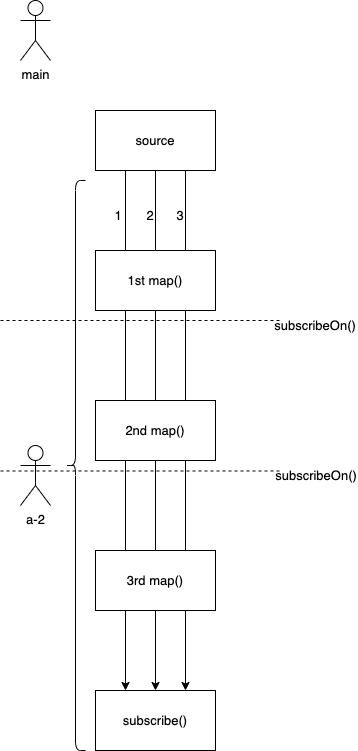
- 1st map()과 2nd map(), 2nd map()과 3rd map() 사이에서 각각 subscribeOn()이 호출됨
- 첫번째 subscribeOn() 앞뒤의 publisher chain과 subscriber chain을 묶어서 스케쥴러A가 담당함
- 두번째 subscribeOn() 앞뒤의 publisher chain과 subscriber chain을 묶어서 스케쥴러B가 담당해야 하지만 같은 스케쥴러가 담당하는 계획이므로 스케쥴러B는 필요없고 스케쥴러A가 계속 맡음
- 내부적으로는 스케쥴러B와 b-1 쓰레드가 생성되지만 스케쥴러A에게 맡겨지면서 자원이 회수되는 것으로 추측함
- 스케쥴러A는 a-2 쓰레드를 생성함
- 하나의 쓰레드로 동작하므로 데이터 아이템 하나씩 source로부터 subscribe()까지 흘러 내려간 다음에 다음 데이터 아이템이 처리됨
- 동시성이 높지 않음
1st map(): scheduler-a-2 1
2nd map(): scheduler-a-2 1
3rd map(): scheduler-a-2 1
subscribe():scheduler-a-2 1
1st map(): scheduler-a-2 2
2nd map(): scheduler-a-2 2
3rd map(): scheduler-a-2 2
subscribe():scheduler-a-2 2
1st map(): scheduler-a-2 3
2nd map(): scheduler-a-2 3
3rd map(): scheduler-a-2 3
subscribe():scheduler-a-2 3
publishOn()과 subscribeOn()을 혼합하여 사용
        Flux.range(1, 3)
                .map(i -> {
                    System.out.println("1st map(): " + Thread.currentThread().getName() + " " + i);
                    return i;
                })
                .publishOn(schedulerA)
                .map(i -> {
                    System.out.println("2nd map(): " + Thread.currentThread().getName() + " " + i);
                    return i;
                })
                .subscribeOn(schedulerB)
                .map(i -> {
                    System.out.println("3rd map(): " + Thread.currentThread().getName() + " " + i);
                    return i;
                })
                .subscribe(i -> {
                    System.out.println("subscribe():" + Thread.currentThread().getName() + " " + i);
                });
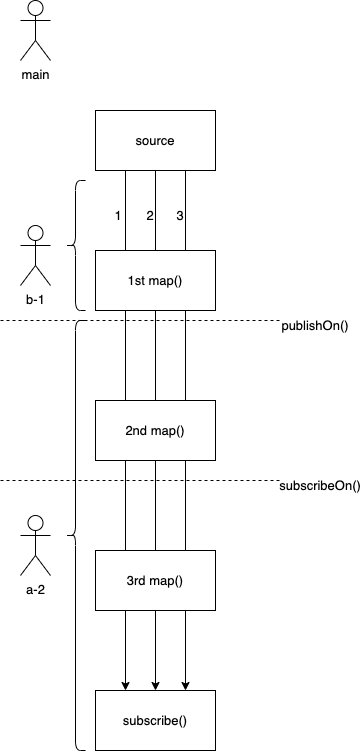
- 1st map()과 2nd map() 사이에 publishOn()이 위치하기 때문에, 뒷쪽 chain을 분리하여 스케쥴러A가 담당함
- 앞쪽은 main이 맡은 채로 2nd map()부터 분리하여 스케쥴러A가 맡게 됨
- 2nd map()과 3rd map() 사이에 subscribeOn()이 위치하기 때문에, 앞쪽 chain과 뒷쪽 chain을 묶어서 모두 스케쥴러B가 담당함
- main에게서 모든 chain을 빼앗아오기 때문에 main이 담당하던 부분을 스케쥴러B가 담당하게 됨
- 혼합해서 사용하는 경우에는 publishOn()에 의해 분리된 스케쥴러가 먼저 쓰레드를 생성함
- 스케쥴러B가 b-1 쓰레드를 생성함
- 스케쥴러A가 a-2 쓰레드를 생성함
- 스케쥴러B가 b-1 쓰레드를 생성함
1st map(): scheduler-b-1 1
1st map(): scheduler-b-1 2
1st map(): scheduler-b-1 3
2nd map(): scheduler-a-2 1
3rd map(): scheduler-a-2 1
subscribe():scheduler-a-2 1
2nd map(): scheduler-a-2 2
3rd map(): scheduler-a-2 2
subscribe():scheduler-a-2 2
2nd map(): scheduler-a-2 3
3rd map(): scheduler-a-2 3
subscribe():scheduler-a-2 3
subscribeOn()과 publishOn()을 혼합하여 사용
        Flux.range(1, 3)
                .map(i -> {
                    System.out.println("1st map(): " + Thread.currentThread().getName() + " " + i);
                    return i;
                })
                .subscribeOn(schedulerA)
                .map(i -> {
                    System.out.println("2nd map(): " + Thread.currentThread().getName() + " " + i);
                    return i;
                })
                .publishOn(schedulerB)
                .map(i -> {
                    System.out.println("3rd map(): " + Thread.currentThread().getName() + " " + i);
                    return i;
                })
                .subscribe(i -> {
                    System.out.println("subscribe():" + Thread.currentThread().getName() + " " + i);
                });
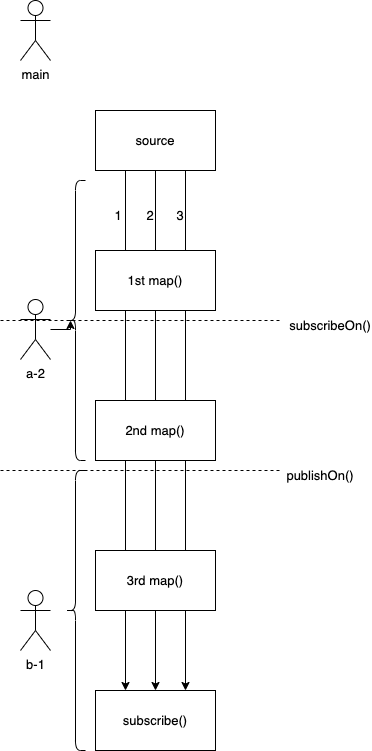
- 1st map()과 2nd map() 사이에 subscribeOn()이 위치하기 때문에, 앞쪽 chain과 뒷쪽 chain을 묶어서 모두 스케쥴러A가 담당함
- main에게서 모든 chain을 빼앗아오기 때문에 main이 담당하던 부분을 스케쥴러A가 담당하게 됨
- 2nd map()과 3rd map() 사이에 subscribeOn()이 위치하기 때문에, 뒷쪽 chain을 분리하여 스케쥴러B가 담당함
- 3rd map()부터 분리하여 스케쥴러B가 맡게 됨
- 혼합해서 사용하는 경우에는 publishOn()에 의해 분리된 스케쥴러가 먼저 쓰레드를 생성함
- 스케쥴러B가 b-1 쓰레드를 생성함
- 스케쥴러A가 a-2 쓰레드를 생성함
- 스케쥴러B가 b-1 쓰레드를 생성함
1st map(): scheduler-a-2 1
2nd map(): scheduler-a-2 1
1st map(): scheduler-a-2 2
2nd map(): scheduler-a-2 2
1st map(): scheduler-a-2 3
2nd map(): scheduler-a-2 3
3rd map(): scheduler-b-1 1
subscribe():scheduler-b-1 1
3rd map(): scheduler-b-1 2
subscribe():scheduler-b-1 2
3rd map(): scheduler-b-1 3
subscribe():scheduler-b-1 3
중첩 구조에서 publishOn()과 publishOn()을 이용한 분리
        Flux.range(1, 3)
                .map(i -> {
                    System.out.println("1st map():" + Thread.currentThread().getName() + " " + i);
                    return i;
                })
                .publishOn(schedulerA)
                .map(i -> {
                    System.out.println("2nd map():" + Thread.currentThread().getName() + " " + i);
                    return Flux.fromIterable(Arrays.asList("A", "B"))
                            .map(j -> {
                                System.out.println("nested 1st map():" + Thread.currentThread().getName() + " " + i + " " + j);
                                return j;
                            })
                            .publishOn(schedulerB)
                            .map(j -> {
                                System.out.println("nested 2nd map():" + Thread.currentThread().getName() + " " + i +
                                        " " + j);
                                return j;
                            })
                            .subscribe(j -> {
                                System.out.println("subscribe():" + Thread.currentThread().getName() + " " + i + " " + j);
                            });
                });
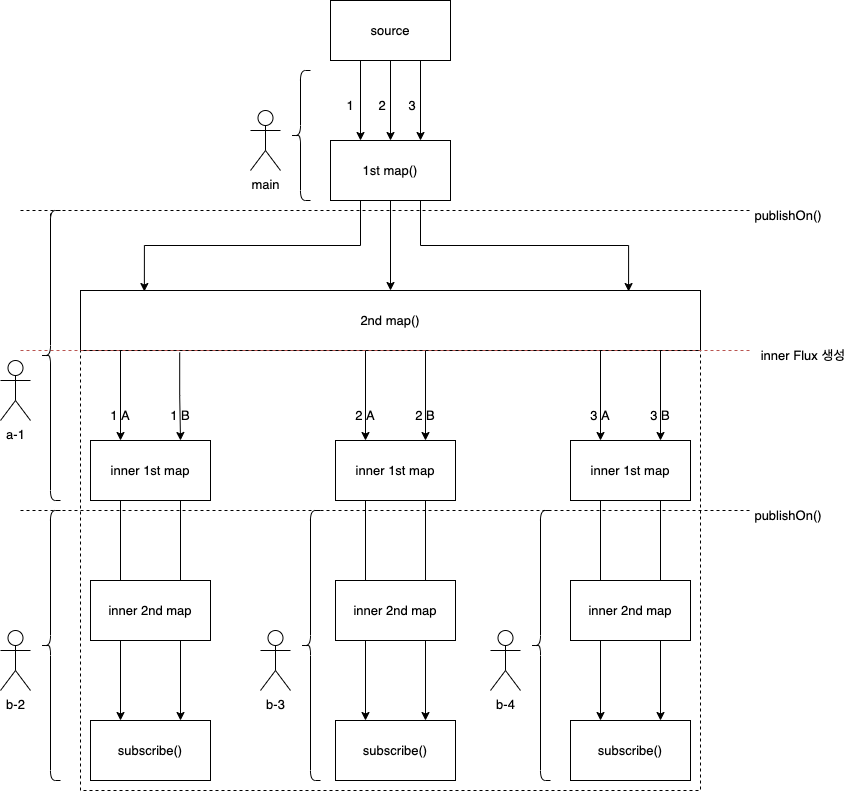
- 1st map()과 2nd map() 사이에 publishOn()이 위치하기 때문에, 뒷쪽 chain을 별도의 스케쥴러A가 담당함
- 2nd map() 내부에서 Flux stream을 새롭게 생성함
- Flux stream이 나눠지면 여기에 데이터를 공급해야 될 가능성이 있으므로, 앞쪽 publisher chain을 처리할 쓰레드가 필요하여 스케쥴러A가 a-1 쓰레드를 먼저 생성함
- 내부 1st map()과 2nd map() 사이에 publishOn()이 위치하기 때문에, 뒷쪽 chain을 별도의 스케쥴러B가 담당함
- Flux stream이 나눠졌기 때문에, 각각을 처리할 쓰레드가 필요하여 스케쥴러B가 b-2, b-3, b-4 쓰레드를 생성함
1st map():main 1
1st map():main 2
1st map():main 3
2nd map():scheduler-a-1 1
nested 1st map():scheduler-a-1 1 A
nested 1st map():scheduler-a-1 1 B
2nd map():scheduler-a-1 2
nested 1st map():scheduler-a-1 2 A
nested 1st map():scheduler-a-1 2 B
2nd map():scheduler-a-1 3
nested 2nd map():scheduler-b-2 1 A
nested 2nd map():scheduler-b-3 2 A
subscribe():scheduler-b-2 1 A
nested 2nd map():scheduler-b-2 1 B
subscribe():scheduler-b-2 1 B
subscribe():scheduler-b-3 2 A
nested 1st map():scheduler-a-1 3 A
nested 1st map():scheduler-a-1 3 B
nested 2nd map():scheduler-b-3 2 B
nested 2nd map():scheduler-b-4 3 A
subscribe():scheduler-b-3 2 B
subscribe():scheduler-b-4 3 A
nested 2nd map():scheduler-b-4 3 B
subscribe():scheduler-b-4 3 B
중첩 구조에서 publishOn()과 subscribeOn()을 이용한 분리
        Flux.range(1, 3)
                .map(i -> {
                    System.out.println("1st map():" + Thread.currentThread().getName() + " " + i);
                    return i;
                })
                .publishOn(schedulerA)
                .map(i -> {
                    System.out.println("2nd map():" + Thread.currentThread().getName() + " " + i);
                    return Flux.fromIterable(Arrays.asList("A", "B"))
                            .map(j -> {
                                System.out.println("nested 1st map():" + Thread.currentThread().getName() + " " + i + " " + j);
                                return j;
                            })
                            .subscribeOn(schedulerB)
                            .map(j -> {
                                System.out.println("nested 2nd map():" + Thread.currentThread().getName() + " " + i +
                                        " " + j);
                                return j;
                            })
                            .subscribe(j -> {
                                System.out.println("subscribe():" + Thread.currentThread().getName() + " " + i + " " + j);
                            });
                });
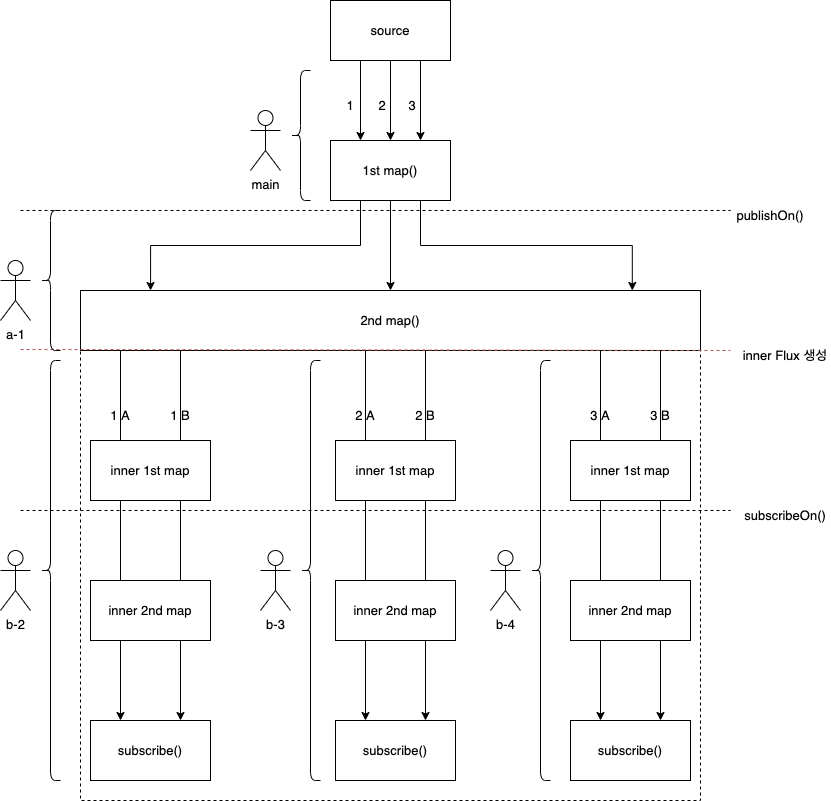
- 1st map()과 2nd map() 사이에 publishOn()이 위치하기 때문에, 뒷쪽 chain을 별도의 스케쥴러A가 담당함
- 2nd map() 내부에서 Flux stream을 새롭게 생성함
- Flux stream이 나눠지면 여기에 데이터를 공급해야 될 가능성이 있으므로, 앞쪽 publisher chain을 처리할 쓰레드가 필요하여 스케쥴러A가 a-1 쓰레드를 먼저 생성함
- 내부 1st map()과 2nd map() 사이에 subscribeOn()이 위치하기 때문에, 앞쪽과 뒷쪽 chain을 별도의 스케쥴러B가 모두 담당함
그러나 바깥쪽과 내부의 Flux stream이 분리되어 있으므로 스케쥴러B는 스케쥴러A가 담당하는 chain까지 넘겨받을 수는 없음- Flux stream이 나눠졌기 때문에, 각각을 처리할 쓰레드가 필요하여 스케쥴러B가 b-2, b-3, b-4 쓰레드를 생성함
1st map():main 1
1st map():main 2
1st map():main 3
2nd map():scheduler-a-1 1
2nd map():scheduler-a-1 2
2nd map():scheduler-a-1 3
nested 1st map():scheduler-b-3 2 A
nested 1st map():scheduler-b-4 3 A
nested 2nd map():scheduler-b-3 2 A
nested 1st map():scheduler-b-2 1 A
nested 2nd map():scheduler-b-2 1 A
nested 2nd map():scheduler-b-4 3 A
subscribe():scheduler-b-3 2 A
nested 1st map():scheduler-b-3 2 B
nested 2nd map():scheduler-b-3 2 B
subscribe():scheduler-b-3 2 B
subscribe():scheduler-b-4 3 A
nested 1st map():scheduler-b-4 3 B
nested 2nd map():scheduler-b-4 3 B
subscribe():scheduler-b-4 3 B
subscribe():scheduler-b-2 1 A
nested 1st map():scheduler-b-2 1 B
nested 2nd map():scheduler-b-2 1 B
subscribe():scheduler-b-2 1 B
중첩 구조에서 subscribeOn()과 subscribeOn()을 이용한 분리
        Flux.range(1, 3)
                .map(i -> {
                    System.out.println("1st map():" + Thread.currentThread().getName() + " " + i);
                    return i;
                })
                .subscribeOn(schedulerA)
                .map(i -> {
                    System.out.println("2nd map():" + Thread.currentThread().getName() + " " + i);
                    return Flux.fromIterable(Arrays.asList("A", "B"))
                            .map(j -> {
                                System.out.println("3rd map():" + Thread.currentThread().getName() + " " + i + " " + j);
                                return j;
                            })
                            .subscribeOn(schedulerB)
                            .map(j -> {
                                System.out.println("4th map():" + Thread.currentThread().getName() + " " + i + " " + j);
                                return "value " + j;
                            })
                            .subscribe(j -> {
                                System.out.println("subscribe():" + Thread.currentThread().getName() + " " + i + " " + j);
                            });
                })
                .blockLast();
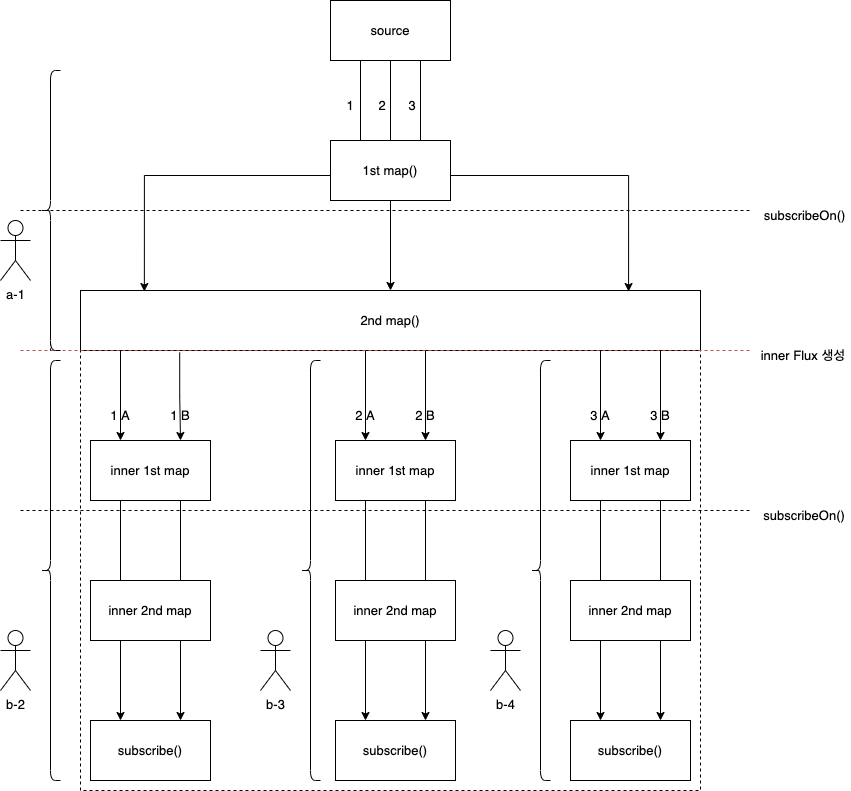
- 1st map()과 2nd map() 사이에 subscribeOn()이 위치하기 때문에 스케쥴러A가 앞쪽과 뒷쪽 chain을 모두 담당함
- 2nd map() 내부에서 Flux stream을 새롭게 생성함
- Flux stream이 나눠지면 여기에 데이터를 공급해야 될 가능성이 있으므로, 앞쪽 publisher chain을 처리할 쓰레드가 필요하여 스케쥴러A가 a-1 쓰레드를 먼저 생성함
- 내부 1st map()과 2nd map() 사이에 subscribeOn()이 위치하기 때문에, 스케쥴러B가 앞쪽과 뒷쪽 chain을 모두 담당함
그러나 바깥쪽과 내부의 Flux stream이 분리되어 있으므로 스케쥴러B는 스케쥴러A가 담당하는 chain까지 넘겨받을 수는 없음- Flux stream이 나눠졌기 때문에, 각각을 처리할 쓰레드가 필요하여 스케쥴러B가 b-2, b-3, b-4 쓰레드를 생성함
1st map():scheduler-a-1 1
2nd map():scheduler-a-1 1
1st map():scheduler-a-1 2
2nd map():scheduler-a-1 2
1st map():scheduler-a-1 3
2nd map():scheduler-a-1 3
nested 1st map():scheduler-b-3 2 A
nested 1st map():scheduler-b-2 1 A
nested 1st map():scheduler-b-4 3 A
nested 2nd map():scheduler-b-2 1 A
nested 2nd map():scheduler-b-3 2 A
nested 2nd map():scheduler-b-4 3 A
subscribe():scheduler-b-2 1 A
nested 1st map():scheduler-b-2 1 B
nested 2nd map():scheduler-b-2 1 B
subscribe():scheduler-b-3 2 A
subscribe():scheduler-b-2 1 B
nested 1st map():scheduler-b-3 2 B
subscribe():scheduler-b-4 3 A
nested 2nd map():scheduler-b-3 2 B
nested 1st map():scheduler-b-4 3 B
subscribe():scheduler-b-3 2 B
nested 2nd map():scheduler-b-4 3 B
subscribe():scheduler-b-4 3 B
중첩 구조에서 subscribeOn()과 publishOn()을 이용한 분리
        Flux.range(1, 3)
                .map(i -> {
                    System.out.println("1st map():" + Thread.currentThread().getName() + " " + i);
                    return i;
                })
                .subscribeOn(schedulerA)
                .map(i -> {
                    System.out.println("2nd map():" + Thread.currentThread().getName() + " " + i);
                    return Flux.fromIterable(Arrays.asList("A", "B"))
                            .map(j -> {
                                System.out.println("3rd map():" + Thread.currentThread().getName() + " " + i + " " + j);
                                return j;
                            })
                            .publishOn(schedulerB)
                            .map(j -> {
                                System.out.println("4th map():" + Thread.currentThread().getName() + " " + i + " " + j);
                                return "value " + j;
                            })
                            .subscribe(j -> {
                                System.out.println("subscribe():" + Thread.currentThread().getName() + " " + i + " " + j);
                            });
                })
                .blockLast();
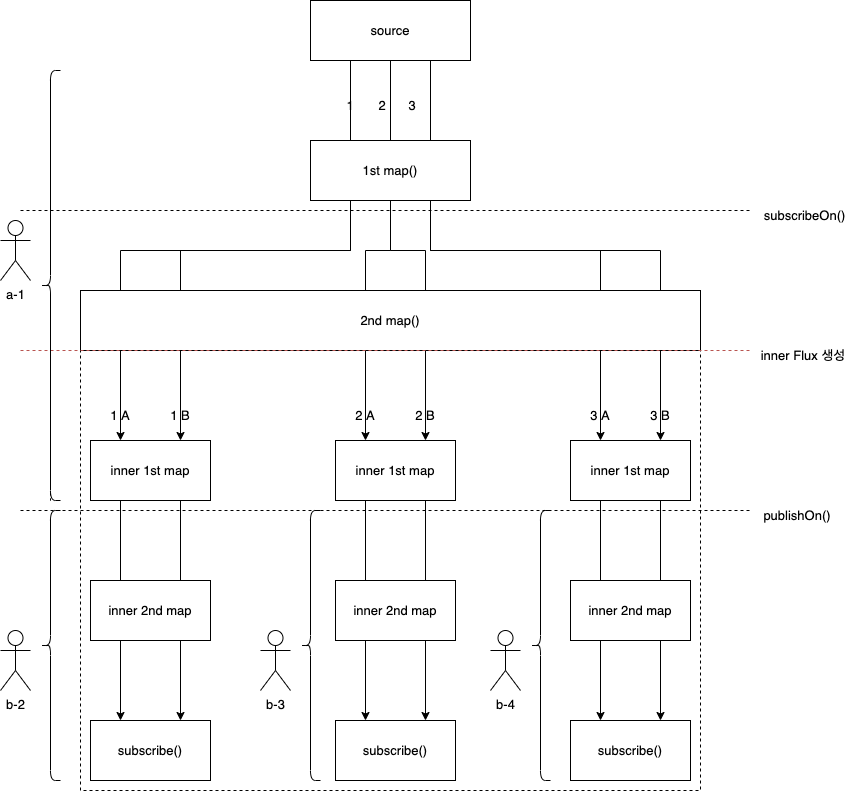
- 1st map()과 2nd map() 사이에 subscribeOn()이 위치하기 때문에, 스케쥴러A가 앞쪽과 뒷쪽 chain을 모두 담당함
- 2nd map() 내부에서 Flux stream을 새롭게 생성함
- Flux stream이 나눠지면 여기에 데이터를 공급해야 될 가능성이 있으므로, 앞쪽 publisher chain을 처리할 쓰레드가 필요하여 스케쥴러A가 a-1 쓰레드를 먼저 생성함
- 내부 1st map()과 2nd map() 사이에 publishOn()이 위치하기 때문에, 뒷쪽 chain을 별도의 스케쥴러B가 담당함
- Flux stream이 나눠졌기 때문에, 각각을 처리할 쓰레드가 필요하여 스케쥴러B가 b-2, b-3, b-4 쓰레드를 생성함
1st map():scheduler-a-1 1
2nd map():scheduler-a-1 1
nested 1st map():scheduler-a-1 1 A
nested 1st map():scheduler-a-1 1 B
1st map():scheduler-a-1 2
2nd map():scheduler-a-1 2
nested 1st map():scheduler-a-1 2 A
nested 1st map():scheduler-a-1 2 B
nested 2nd map():scheduler-b-2 1 A
1st map():scheduler-a-1 3
2nd map():scheduler-a-1 3
nested 1st map():scheduler-a-1 3 A
nested 2nd map():scheduler-b-3 2 A
subscribe():scheduler-b-2 1 A
nested 2nd map():scheduler-b-4 3 A
subscribe():scheduler-b-4 3 A
nested 1st map():scheduler-a-1 3 B
nested 2nd map():scheduler-b-2 1 B
subscribe():scheduler-b-2 1 B
nested 2nd map():scheduler-b-4 3 B
subscribe():scheduler-b-3 2 A
subscribe():scheduler-b-4 3 B
nested 2nd map():scheduler-b-3 2 B
subscribe():scheduler-b-3 2 B
Wrap-up: 왜, 언제 사용해야 하나?
앞서 간단히 언급했던 것처럼, publishOn()은 빠른 publisher와 느린 subscriber로 구성된 chain에 사용하고, subscribeOn()은 반대로 느린 publisher와 빠른 subscriber로 구성된 chain에 사용하는 게 적절함
일반적으로 내부 서비스 로직이 좀 더 빠르고 외부 의존성은 더 느리거나 IO blocking이 발생할 수 있음. 외부 의존성(웹서비스나 DB서버)에서 데이터를 읽어오거나 쓰는 경우에는 모두 별도의 스케쥴링을 적용하는 게 바람직함. 그렇지 않으면 main 쓰레드가 block되어 전체 서비스가 멈추기 때문임.
write to external
외부 의존성에 쓰는 경우에는 외부 의존성에 가까운 subscriber쪽 chain을 별도의 스케쥴링으로 관리할 수 있도록 분리하는 게 필요함. 여기에 적합한 것이 publishOn()임
database Slow_External_Service1 {
}

cloud Slow_External_Service2 {
}

package Internal_Service {
	component main_thread
  component thread1
  component thread2
}

main_thread ..> thread1: create a thread
main_thread ..> thread2: create a thread
thread1 --> Slow_External_Service1: data stream\nIO blocking
thread2 --> Slow_External_Service2: data stream\nIO blocking
read from external
외부 의존성으로부터 읽어오는 경우에는 외부 의존성이 데이터를 생성하는 속도에 맞춰서 내부 서비스 로직이 움직여야 하므로 같은 스케쥴링이 적용되지만 main 쓰레드와는 별도의 스케쥴링으로 관리되는 게 바람직함. 그러므로 subscribeOn()을 이용하면 됨
database Slow_External_Service1 {
}

cloud Slow_External_Service2 {
}

package Internal_Service {
	component main_thread
  component thread1
  component thread2
}

Slow_External_Service1 --> thread1: data stream\nIO blocking
Slow_External_Service2 --> thread2: data stream\nIO blocking
main_thread ..> thread1: create a thread
main_thread ..> thread2: create a thread